

DETAILS
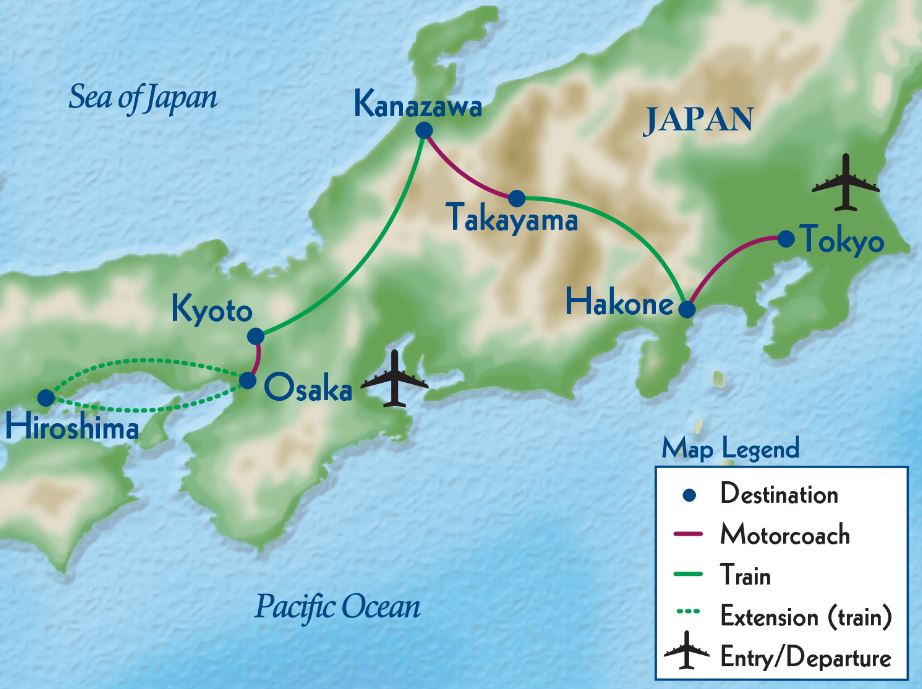
Begin in Tokyo, with two full days exploring Japan’s capital. Travel to Fuji-Hakone-Izu National Park to experience the world’s most revered volcano, followed by an overnight in a ryokan, a traditional Japanese inn. Take a bullet train to historic Takayama, and attend a traditional Japanese tea ceremony. Explore culturally rich Kanazawa before concluding with three nights in Kyoto, Japan’s cultural capital. An optional three-day, two-night post-tour extension to cosmopolitan Hiroshima, the “City of Peace,” is also available.
- Pricing from
- $7,195
Space is limited to 24 guests, CLICK HERE or call 888-370-6765 to reserve today!
- Trip Type
- Group Travel Tour, Individual Travel Tour, International Land & Rail Tours
- Departure Dates
-
Oct 14, 2026 - Oct 26, 2026
October 26-28, 2026
Post-Tour Extension – Hiroshima: City of Peace
Discover the city reborn from the atomic destruction of World War II, a modern and cosmopolitan urban center whose residents warmly welcome American visitors.
Your Tour Price Includes
• Rail transportation Kyoto/Hiroshima, Hiroshima/Osaka
• 2 nights’ accommodations at Hotel Granvia Hiroshima (First Class)
• 3 meals: 2 breakfasts, 1 lunch
• Extensive included sightseeing: excursion to Miyajima Island and Daisho-in Temple; Hiroshima touring by local “Hiroden” train; visit to Peace Memorial Park and Museum; Atomic Bomb Dome
• Services of an Odysseys Unlimited Tour Director
• Gratuities for dining room servers, hotel porters, and all drivers
3 days/2 nights for $1,195 total price Single Supplement: $245
Flexible Travel Options
We are pleased to announce that for departures starting in 2026, we are offering a new Flexible Travel Option (FTO) program. This program will allow guests who book their airfare through Odysseys Unlimited to customize their travel experience in several ways:
- Arrive at your destination up to three days before the tour’s scheduled start date
- Extend your travel beyond the tour’s end date
- Purchase transfers from the arrival airport to the tour’s first hotel, and/or from the tour’s final hotel to the departure airport, to coincide with your alternate travel dates
- Reserve extra nights at the first and/or final hotel on your tour to coincide with your alternate travel dates
Should you elect to use our FTO program, a one-time fee of $50 per person would be added to your reservation. Your Travel Counselor would advise you of pricing and availability for airport transfer(s) and/or additional hotel night(s) at the time of booking. For more information, please call our Customer Service department at the number(s) below.
Land-Only Transfer Policy
Airport transfers to and from the first and last hotels, as always, are not included in the land-only price of a tour. That said, should you wish to join an airport transfer through Odysseys Unlimited, you may purchase them after arranging your own airfare by calling our Customer Service department no later than 30 days prior to your departure.
It is important to note that guests will no longer be able to join an airport transfer that has not been purchased in advance; additionally, transfers may not be available for purchase on all tours. You can find this updated policy information detailed in our new Airport Transfers document now available to view on our MyOdyssey Portal.
Questions
Should you have any questions about either of updates, please don’t hesitate to contact us by email or by calling our Customer Service department, toll-free at (888) 370-6765, Monday through Friday from 9:00 a.m. to 7:00 p.m. ET.
TOUR MAP
ITINERARY
-
day 1
Depart U.S. for Tokyo
-
day 2
Arrive Tokyo
Upon arrival in Japan’s financial, commercial, and political capital, we travel to our hotel (note: check-in is at 3:00 p.m.). As guests’ arrival times may vary, we have no scheduled activities or meals planned
-
day 3
Tokyo
We begin our day by meeting with our fellow travelers and tour director for a welcome briefing on the journey ahead, followed by a tour of a small part of the city. Tokyo is a vast metropolis, which actually functions more like its own small country, comprising 23 wards and 26 self-governed cities. Tokyo’s population numbers over 14 million in the city proper, and the city sprawls across 847 square miles. It is also the center of the Greater Tokyo Area, which is, with a population of more than 37 million, the most populous metropolitan area in the world. Amazingly, it has endured earthquakes, fires, and the U.S. air raids of World War II to emerge as one of the world’s leading cities. Tokyo has managed to successfully merge the old and the new to become a fascinating cosmopolitan destination, as we see during our stay. Our half-day excursion in Ancient Tokyo includes a visit to the famed Meiji Jingu Shrine, a peaceful enclave of temples and gardens dedicated to late 19th-century Emperor Meiji and his wife. Built in traditional Shinto style with low wooden buildings surrounded by square courtyards, the shrine is one of Tokyo’s most popular attractions. Also on today’s itinerary is a visit to the gallery of preeminent calligrapher Koshun Masunaga, where we learn about the ancient art of artistic writing and browse the collection. Our tour ends in Ginza, Tokyo’s famed shopping, dining, and entertainment district, where we can stay to explore the luxury department stores, boutiques, and galleries as we wish, or return to our hotel for an afternoon at leisure. Tonight, we gather for a welcome dinner at a local restaurant.
-
day 4
Tokyo
Today we visit the Imperial Palace, surrounded by moats and ramparts and home of the Imperial Family. Called Kokyo, the huge complex dates to the 15th century, when territorial disputes required massive fortifications and complex societal norms demanded elaborate palaces to reflect the high positions of the feudal lords. Here, we visit the East Gardens, part of the innermost circle of defense of the historic Edo Castle that once stood here. We then continue on to the Asakusa Kannon Temple, which contains a golden image of the Buddhist Kannon, goddess of mercy. According to legend, two fishermen dragged the statue from the sea in 628 … but visitors cannot see it since it is hidden from the public. However, guests can make their way to the front of the temple to bathe in smoke from the incense cauldron; it is said that the smoke brings good health. Then, we have time to explore the Nakamise shopping arcade outside the temple, filled with stalls selling local dishes, Buddhist trinkets, and popular souvenirs. From here, we visit the Tokyo National Museum, housing an extensive collection of art and antiquities from Japan and other Asian countries. This afternoon is at leisure for independent exploration; lunch and dinner are on our own today in this city with endless dining options.
-
day 5
Tokyo/Fuji-Hakone-Izu National Park/ Hakone
Japan’s pastoral side is on tap today as we leave Tokyo by motorcoach for Fuji-Hakone-Izu National Park. The park is home to one of the most photographed sights in Japan, if not the world: Mt. Fuji, almost perfectly symmetrical and standing regally at 12,388 feet high. A dormant volcano, Fuji-san as it is known to the Japanese, last erupted in 1707 and the resulting ash reached all the way to Tokyo, where it covered buildings. The mountain’s majesty is breathtaking, as writers and artists have attested for centuries. We first learn about the environmental and conservation efforts on the mountain at the Mt. Fuji World Heritage Center and then take a leisurely cruise on Lake Ashi, where we can take in scenes of the whole park and, with luck, see Mt. Fuji itself. Leaving the park, we continue on to the town of Hakone and our traditional ryokan lodgings for the night – and a special night it is indeed. Upon arrival at our intimate inn, we are shown to our Japanese-style rooms where we remove our shoes before entering. We later enjoy a traditional Kaiseki dinner, a multi-course meal consisting of a number of artfully arranged small dishes. Tonight we sleep peacefully in a room of serene, minimalist Japanese design. Please note: Because of limited storage space on the train from Hakone to Takayama, along with the
intimate nature of the ryokan, you will only be able to bring your carry-on luggage with you for your stay at the ryokan. You will meet your checked luggage upon arrival at the hotel in Takayama. -
day 6
Hakone/Takayama
Our journey continues as we travel via bullet train and the Limited Express Hida to the Hida Mountain town of Takayama, considered one of Japan’s most attractive destinations. Upon arrival, we explore the San-machi-suji district, part of Takayama’s beautifully preserved Old Town that dates to the Edo period of 1600 to 1868. Here, in feudal times, wealthy merchants lived amidst the authentically preserved small inns, teahouses, peaceful temples, and sake breweries that still operate as they have for centuries. Before we leave, guests have the option to buy a bento box lunch (a food box artfully packed with Japanese specialties). This afternoon, we attend a traditional Japanese tea ceremony where we learn the 12th-century style of prepping tea. We dine tonight at our hotel.
-
day 7
Takayama
Today we begin our full-day tour of Takayama with an early-morning visit to the centuries-old Miyagawa Morning Market, where stalls selling everything from fresh fruit, vegetables, and flowers to pickles, handicrafts, and fish line the streets leading to the river. We then bring our spoils to our next activity – a hands-on authentic Japanese cooking class. After we enjoy the fruits of our labor for lunch, we visit the Takayama Jinya, a former government outpost, and discover its long list of past uses. After leaving Takayama Jinya, we visit a sake brewery (a local rice wine liquor) where we taste the variations of this warm national beverage and learn about the unique traditional brewing methods. We also take another pass through Takayama’s Old Town. Before returning to our hotel late this afternoon, we have time to explore the sweet shops and stores selling traditional crafts. Dinner today is on our own.
-
day 8
Takayama/Shirakawago/Kanazawa
This morning, we depart for Shirakawago Gassho-zukuri Village, a UNESCO World Heritage Site comprising traditional thatched-roof homes. In addition to its status as a World Heritage Site, the village is also a vibrant community whose residents work together to preserve the Gassho architecture style unique to this region: wooden houses with steep thatched roofs made to withstand heavy snow. We tour a Gassho-style residence and explore the Ogimachi District – a cluster of 59 Gassho-style houses preserved to show how its inhabitants lived long ago. These houses were actually relocated from their former locations in a nearby village which was razed to make way for a dam. After touring here, we depart for Kanazawa, an alluring city that survived the ravages of World War II because of its out-of-the-way location between the mountains and the Sea of Japan. Though somewhat off the beaten tourist path, Kanazawa is prized as the country’s best-preserved Edo-period city (along with Takayama). Before reaching our hotel, we visit Gokayama Village for lunch at a local restaurant and to experience traditional Japanese washi papermaking. We arrive at the hotel in Kanazawa in the late afternoon and dine together here tonight.
-
day 9
Kanazawa
Our full day of touring this culturally rich city includes the Hakukokan Gold Leaf Center, a museum that celebrates the art and craft of gold leaf technology and a collection dating to the late 16th century. A center of gold leaf craft, Kanazawa produced the gold leaf covering Kyoto’s Golden Pavilion that we will see on Day 11. Next, we call on the Kutani Kosen Kiln, where artists fashion prized, highly decorated pottery. We then continue on to Omicho Market – Kanazawa’s largest food market dating back to the Edo Period – where 200 shops and stalls line the streets selling everything from fresh seafood and produce to flowers and clothing. After browsing the market’s wares, we head to our final stop of the day: the renowned Kenrokuen Garden, a national landmark whose origins date to 1676. One of Japan’s three finest traditional gardens, Kenrokuen (Garden of Six Attributes) represents the six qualities required for the perfect garden: extensiveness, artifice, antiquity, waterways, panoramic views, and quiet seclusion. Its trees, ponds, waterfalls, and flowers stretch over grounds of 25 acres. Dinner is on our own tonight.
-
day 10
Kanazawa/Kyoto
This morning we board the train for the two-hour journey south to Kyoto, Japan’s Imperial Capital for a millennium and now the country’s cultural and artistic capital. A true gem with more than 1,600 temples, hundreds of shrines, three imperial palaces, artful gardens, and well-preserved wooden architecture, Kyoto embodies Japan’s rich culture and complex history. Japanese gardens, traditional cuisine, and superb crafts thrive here, attracting legions of visitors and Japanese alike. Upon arrival, we visit Nijo-jo Castle (c. 1603), the extravagant residence and fortifications of the shoguns who ruled Japan for more than 250 years. Featuring imposing stone walls and deep moats, the castle has many interior security measures as well, including hidden rooms for the shogun’s bodyguards and “nightingale floors” which purposely squeak when stepped on to alert occupants of intruders. Then, we continue on to the Kyoto Museum of Crafts and Design (commonly known as the Fureaikan), showcasing all of Kyoto’s 74 different métiers (including lacquerware, textiles, woodworking, metalwork, basketry, and more) in one place. Late this afternoon, we reach our hotel, where we gather for dinner together.
-
day 11
Kyoto
More of Kyoto is on tap today, beginning with a visit to the otherworldly Arashiyama Bamboo Grove; the Kyoto Museum of Traditional Crafts (Fureaikan), showcasing all of Kyoto’s 74 different métiers in one place; and Nijo-jo Castle (c. 1603), the extravagant residence and fortifications of the shoguns who ruled Japan for more than 250 years. Dinner tonight is on our own in this traditional, yet modern city.
-
day 12
Kyoto
We continue our encounter with Kyoto today, first at the important Fushimi Inari shrine, with its trails straddled by red torii gates; Sanjyusangendo Hall (c. 1266), an important Buddhist temple housing 1,000 statues of the Thousand-ArmedKannon deity; and Nishiki Market, “Kyoto’s Kitchen” of restaurants, stores, and stalls selling everything foodrelated. Then this afternoon is at leisure; tonight, we toast our adventure at a farewell dinner at a local restaurant.
-
day 13
Depart Kyoto for U.S.
This morning we travel by motorcoach to Osaka, where we board our return flight to the United States.
Everything you need to know about the tour
Save this information for later by downloading the full tour brochure.
Be prepared with the National Trust Travel Plan
Since 1973, USI Affinity Travel Insurance Services has served travelers just like you, to help protect their travel plans